
The province of Friesland (The Netherlands) requested research to be done in order to determine the best processing route of roadside grass. Ekwadraat, Ecoras and Bioclear earth performed a study comparing multiple processing routes in order to create a multicriteria-analysis (MCA). A large part of this MCA is a life-cycle analysis, which is explained below.
Ekwadraat, Bioclear Earth, and Ecoras, commissioned by the Province of Friesland, have developed a decision framework for the processing of verge grass. This decision framework compares different processing routes for verge grass in terms of greenhouse gas and ammonia emissions. The entire chain is considered, from mowing and collecting to the application of the end product. In addition, the routes are evaluated based on various societal, economic, and environmental criteria in an overarching multicriteria analysis (MCA).
The following routes are included in this analysis:
As part of the MCA, a life-cycle analysis has been conducted. For all the processing methods mentioned above, the impact of nitrogen and CO2 has been determined. The model is based on three steps (assuming that road verges are mowed):
Utilization: transport, collection of roadside mowing, and transfer/silage.
Processing roadside mowing into a new end product.
Emissions during the use/application phase, avoided emissions compared to fossil products, and end-of-life.
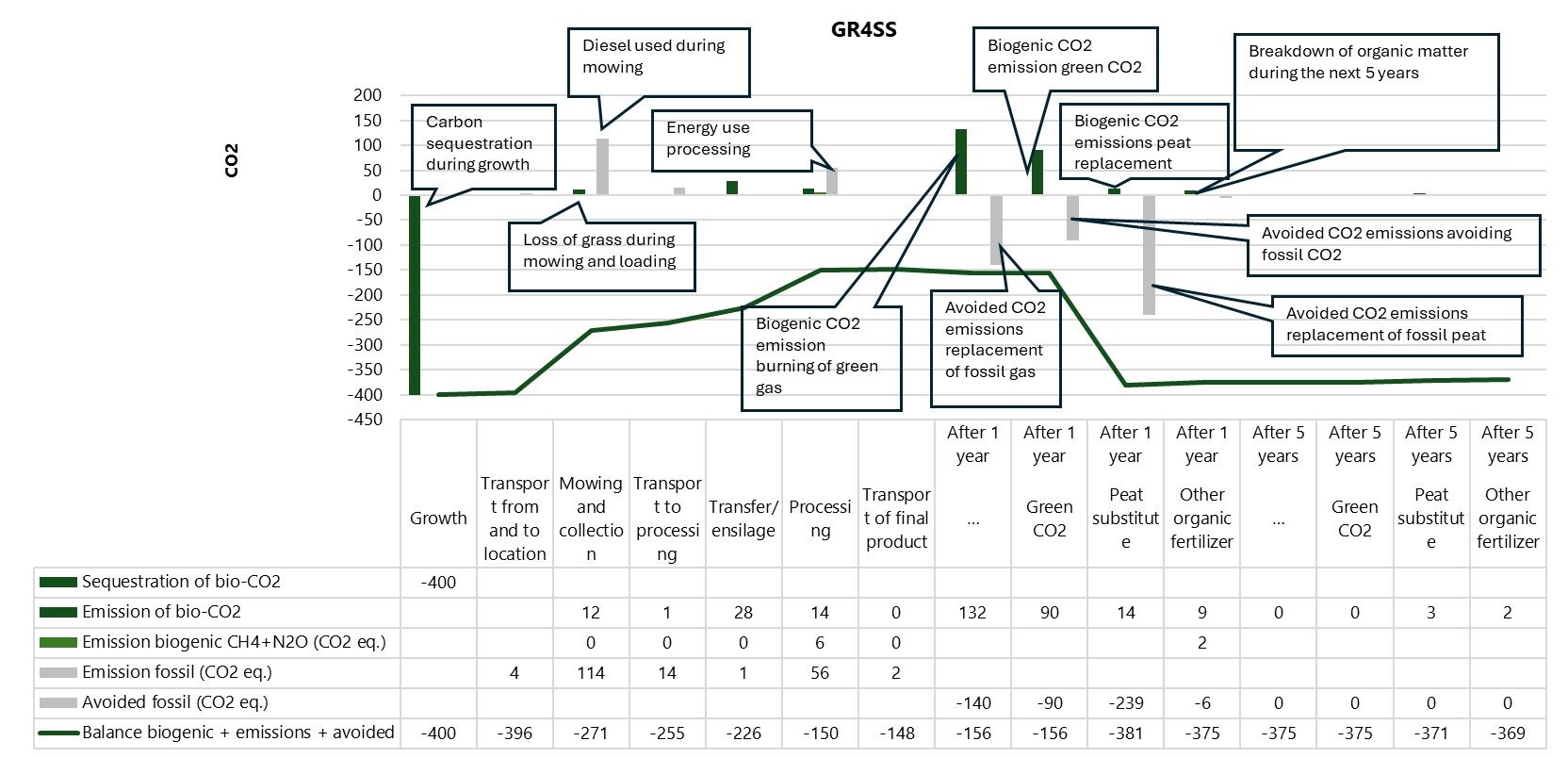
Figure 1 illustrates the life-cycle analysis of roadside mowing in the case of monodigestion of roadside grass. The grass sequesters approximately 400 tons of CO2 per ton of roadside grass during its growth. In the mowing process, there is emission during the processes of mowing, transportation, and processing of the grass. This increases the CO2 balance to approximately 150 kg/ton, as can be seen in figure 1. Afterwards, the CO2 balance decreases again to approximately 369 kg/ton of roadside grass. This occurs due to the replacement of fossil natural gas, fossil CO2, synthetic fertilizer from natural gas, and peat in potting soil. The CO2 balance decreases during the processing of the grass into the four resulting products. Ultimately, the CO2 balance turns negative, reaching a CO2eq emission reduction of 369 kg five years after mowing.
Further life-cycle analyses
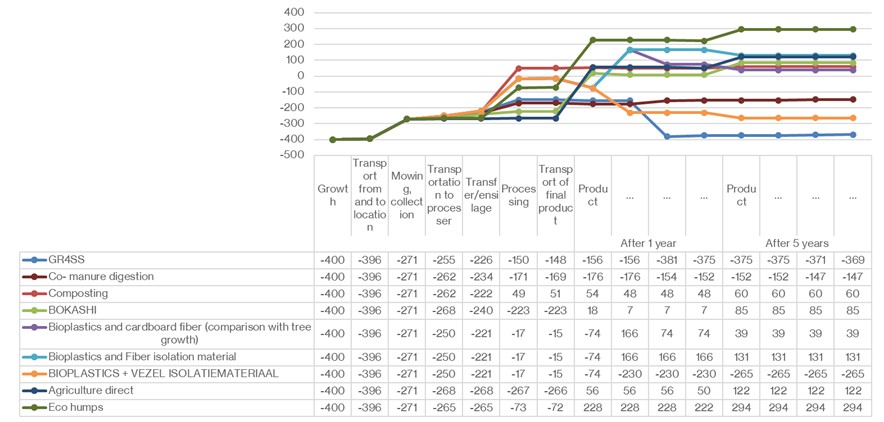
Similar studies have been conducted for other processing methods, and they also show a negative CO2 balance. For instance, in the production of bioplastics, the use of oil for plastics is avoided. Figure 2 compares all processing methods, revealing that GR4SS is the most sustainable processing route for roadside mowing. This is because it produces products that replace fossil alternatives.
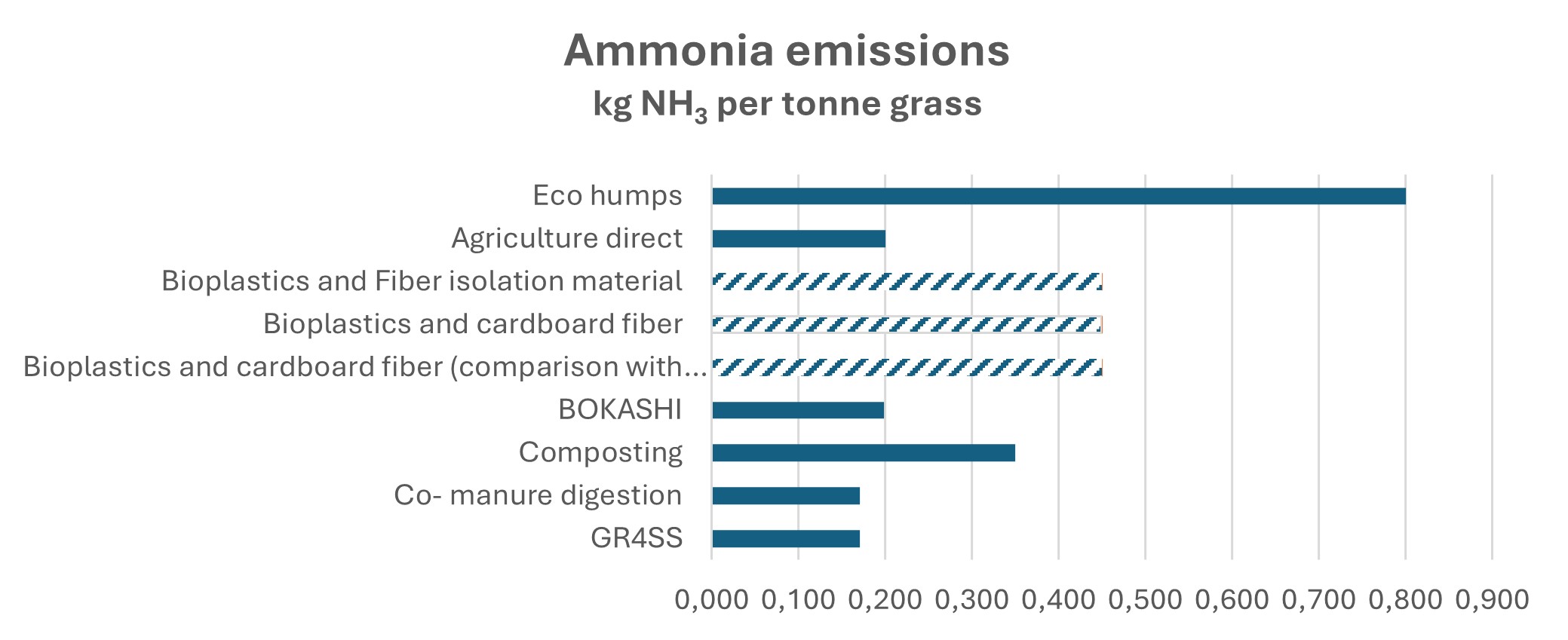
In Figure 3, the ammonia emissions from various scenarios are depicted. The striped pattern for ‘Bioplastics’ indicates that the results are uncertain (a worst-case scenario is taken into account). ‘Ecohopen’ is a rough estimate based on composting data. The small red portion represents cardboard fiber. For the insulation material route, there was insufficient information available.
Ammonia (NH3) is not a greenhouse gas but leads to eutrophication in nature and on farmland, which deteriorates biodiversity. Additionally, these nitrogen compounds contribute to the reduction of air quality and pose health risks.
In the case of GR4SS, the grass is ensiled after mowing. After ensiling, the grass is digested under anaerobic conditions. The digestate is also composted. This occurs indoors. During this process, air is extracted and passed through an air scrubber. In the air scrubber, a significant portion of the ammonia is filtered. Ammonium sulfate is formed in the air scrubber, which is a nitrogen concentrate suitable as a fertilizer substitute. Because composting occurs indoors with air scrubbers, the ammonia emissions are lower compared to processes such as traditional composting or ‘Ecohopen’.
The independent research firm CE Delft has validated the calculations for the CO2 and ammonia balances:
"Ekwadraat, Bioclear Earth, and Ecoras, commissioned by the Province of Friesland, have developed a decision framework for the processing of roadside grass. This decision framework compares various processing routes of roadside grass in terms of greenhouse gas and ammonia emissions. The entire chain is considered, from mowing and gathering to the application of the end product. Additionally, the routes are evaluated based on various societal, economic, and environmental criteria in an overarching multicriteria analysis (MCA). The following routes were included: GR4SS, co-digestion, composting, bokashi, bioplastics plus cardboard fiber, bioplastics plus fiber insulation material, direct agriculture, and eco heaps. CE Delft has validated the decision framework, focusing on the conducted emission study. Our conclusion is that the roadside grass decision framework and emission study have been conducted thoroughly. The identified uncertainties in the emission data do not impact the ranking of the processing routes in terms of net greenhouse gas emissions. The finding that the monogas digestion route leads to the lowest net greenhouse gas emissions among the considered routes is thus reliable. In this route, the digestate remaining after digestion is used as a substitute for peat in potting soil production, contributing to a low net emission.''